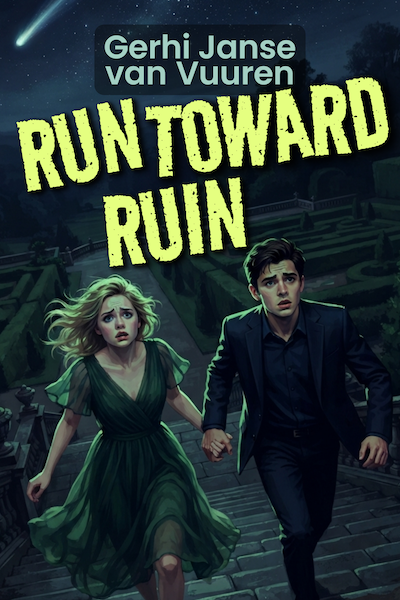
Run Toward Ruin – Chapter 7
When they debate the comet Darius half-remembers an old name. The debate is cut short when Cora vanishes, then reappears soaked and shaking, a drowned omen.
7. Drowned Omen
Hass was back on his feet, arms crossed. “I’ve steered by the sky on three crossings, I know what moves up there and how fast, and that was something different.”
A pause as the others nodded, listened. He had said it like somebody who’d actually been trusted with a wheel and a compass, which shut them up for a second.
“So what was it, then?” asked Cora.
“Sailors call it a drowned star—it means the sea’s swallowed a ship in the night, somewhere far off, and the light is what’s left of it.”
Darius twisted a napkin in his hands. How can Hass say this nonsense so seriously and everybody listens to him as if he had it right?
Hass leaned over and spat loudly across the balustrade.
“Ew, sis man,” said Flawia. “That’s disgusting.”
“Bad luck to watch it cross overhead—you’re supposed to look away and spit, else it marks you.”
Flawia wrinkled her nose. “I’m not spitting.”
“None of us spat,” Cora said.
Somebody had to set Hass right. Darius took a breath but Kaarle got the words out first. “That’s not a real thing, Hass, that’s a story old men tell to scare cabin boys.”
“I’m just telling you what I was told.”
“Did we discover a new comet?” asked Flawia.
Cora looked away to where the light had faded. “It’s still a comet. My mother has a book that lists them by colour.”
“No, I’m sure it is listed. I think the green could mean the harvest’s going to be good.”
“It’s not—!” Darius started.
He must have said it pretty loud because Cora jumped and looked at him with big eyes.
Piers leaned forward with his elbows on his knees. “We should go look through the books in the library. See if we can find it.”
Flawia pouted. “The library is closed now.”
With a clasp of his hands Hass made up his mind “Tomorrow then. It must be catalogued somewhere. A ship’s log or something.”
“My grandmother would say it’s an omen. A green light in the east means somebody is going to be married within the year.”
Kaarle leaned forward from where he stood behind Sabina. “Was this predicted on any of your charts?”
“You mean grandfather’s charts?” She shrugged. “I don’t know. He does not let us near any of them.”
Darius had been near them. Too often and for too long.“This wasn’t… this was not supposed to happen. Oswin did not mark this.”
Sabina reached a hand for Kaarle and looked at Darius, her lips pressed together. She knew what it meant for their grandfather not to have taken a celestial event like this into account. The charts that gave them all certainty and guidance had a huge gap right in the middle of it. And this time it was not because Oswin kept it hidden.
“There’s no record of this, then?” Kaarle said.
“No,” Darius said. “There isn’t.”
Flawia was still looking straight up, her voice quiet. “It was so loud.”
“It didn’t make any sound,” Piers said.
“I know,” Flawia said as she looked up at the sky. “That’s what I mean. Flawia scanned the sky again. “The comet was so loud, and really, really pretty, right?”
Darius wished he had a cane he could stamp on the ground to get their attention and make them listen. “It’s not a rotten comet. Comets don’t move like that.”
“It sure looked like one,” snapped Flawia, as if Darius had taken her comet away from her.
“That’s not—a comet would be visible for—it has a tail, it behaves like a comet…”
“A falling star then?” asked Cora.
“…it’s more like a—except it’s not a falling star either, it didn’t fall, and it was—”
“It wasn’t a comet,” Darius said, not loudly, but it cut under Flawia’s theory easily enough that everyone turned.
“How do you know?” Flawia asked, sounding a little stung.
“Because comets curve.” He used his hands to indicate but it felt as if he was flapping his arms. “They have a path you could chart many… hundreds of years before. If you had the records.”
He knew this because he’d sat through dozens of Oswin’s work sessions bored out of his skull, listening to exactly this kind of calculation.
“Maybe it’s a weird comet,” Kaarle offered.
“No such thing as a weird comet. That didn’t bend. It went dead level across the sky like it was drawn with a ruler.”
“Maybe it’s a small one. A baby comet.”
“That’s not—that’s not a thing, Flawia.”
“Fine, so what was it, then?” Hass said.
Darius hesitated. “I think it had a name. An old one.”
That got silence, for a second—the good kind, the kind where people are actually listening.
“What, like—it’s called something?” Cora asked.
He frowned, chasing it. “I can’t remember the name properly. Jamais—something. Jamais Dame, maybe.”
“You’re making that up,” Hass said with a sneer.
“I’m not. I just can’t remember all of it.”
“Convenient.”
“It’s not convenient, it’s annoying,” Darius snapped. The not-remembering itched at him badly.
“So it’s an omen, like Sabina said,” Cora said.
“I didn’t say it’s an omen. Whatever it is, it’s rare, and old.” He looked back up at the empty stretch of sky where the tail had burned out last. “That’s just… It’s not the same as not knowing what it is.”
“So we don’t actually know anything,” Hass said. “That’s your big answer.”
“I know it wasn’t a comet. I know it had a name once. That’s two more things than the rest of you have.” Darius said.
Nobody argued with that. Darius looked them over—Hass and Flawia and Bernat, Piers, Kaarle, his sister—waiting for them to try.
“Where’s Cora?” he asked.
Darius looked across at Sabina and Kaarle. Sabina scanned the terrace from house to the garden. Kaarle faced out looking at the dark end where the terrace turned the corner of the house.
“She was just here,” Sabina said.
At the far end of the table Flawia sat on a chair’s armrest, her glass held in one hand. With the other she pointed at the balustrade close to her.
“Cora was standing right here, talking about something,” she said. “I wasn’t really listening. She was saying something about a flood.”
“A flood,” Hass repeated.
“A flood that happened here, on this terrace. Some old story. I don’t know.” Flawia looked at the spot. “And when Darius shouted I looked up and she wasn’t there.”
“She’s probably gone inside,” Piers said. “If she was tired—”
“She wasn’t tired.” Flawia snapped this without looking at Piers. “She’d have said.”
“She might have gone to the garden,” Kaarle said.
Flawia fumbled with her glass. “The garden’s dark.”
“I know she was just here.” Hass turned to look at the end of the terrace. “Cora.”
He walked to the top of the steps that led down toward the garden and called Cora’s name again, loud enough that it echoed back from across the lake.
Darius felt Sabina’s hand close briefly on his arm — meaning: do something about the volume — and he had absolutely no idea what he was supposed to do about that and did nothing.
The garden was quiet.
Darius stood up. He’d made a complete nothing of the comet conversation. He could at least move to the balustrade and look.
“I’ll check the lower—”
He didn’t finish.
Cora was there, standing right next to him at the balustrade where Flawia said she had been, with her arms out slightly from her sides and her face the colour of old paper. Her hand reached out and gripped onto his arm.
Her fingers were cold. She was soaked, her clothing plastered to her skin, her hair drenched, as if she had been pulled out of a river. A dark puddle was forming around her feet.
Hass crossed the distance in three steps. “Cora. Cora, what—where—”
She didn’t answer. She was breathing in short shallow pulls, her eyes running around the group, like she was checking that they were all real.
He looked back at Cora, standing there drenched and shaking in the warm night air, and thought: where was the flood. Darius had opened his mouth.
“Did you fall in the lake?”
Every head turned toward him.
Hass looked at him with an expression that crossed the full distance between disbelief and contempt.
Darius closed his mouth.
The terrace went absolutely silent.
People stared at him.
Then they gathered in the shadow of the house, the eight of them, and Darius on the outside without quite meaning to, the way he always seemed to end up on the outside of things.
They—mostly the girls Sabina and Flawia helped Cora to a chair.
Cora was shaking. A fine, continuous shiver, her jaw tight against it. Hass found a jacket to wrap around her shoulders and Flawia held out a napkin, and Cora took it and pressed it to her face.
“I’m fine,” she said, muffled by the napkin.
“You’re not,” Sabina said.
Her face was steady in the low lamplight.
Darius watched her closely. He should do something useful. He reached for his buttons. “I can give her my shirt.”
“We have a jacket, Dari,” Sabina said, without looking at him.
“Right.” He stopped with his shirt half undone. “Do you want—” he started picking up a cushion.
“Put that down,” Sabina said.
He put it down. She was in charge now.
“Tell us from the beginning,” Sabina said, her voice even.
Cora took a breath.
“I was thinking back. The flood—when the lake came up and the whole estate looked like a sinking ship. I had my hands on the balustrade and then — everybody was gone.”
“The terrace was empty. It was daytime but the sky was grey, no sun, and there was a torrent coming down — not just rain, a flood — and the water was already at the top of the steps and moving over the edge of the terrace.”
“I ran for the house doors. Locked. I hammered on them and nobody came. The water was over my feet by then, cold, and I—” She stopped. “I went back to the balustrade. I put my hands on it. And I was back.”
Sabina went quiet, eyes fixed somewhere past Cora’s shoulder. “And you were thinking about the flood when it happened?”
“The flood was what, twenty years ago?”
“Twenty-five,” Kaarle said from the edge of the shadow. “My grandmother talks about it. She was young.”
Flawia opened her mouth and closed it again. She settled near the bench, knees drawn up. “Did you eat anything strange at supper? I’m asking because that fish thing looked strange.”
“I wasn’t drugged,” Cora said.
“Would you prefer cuckoo?”
Cora almost smiled. “It wasn’t a dream either,” she said. “I know the difference between dreaming and standing on stone with rain coming down hard enough to hurt.”
“We need to get your mother,” Flawia said.
“Not yet,” Sabina said. “Give her a minute.”
“She’s going to want to know—”
“A minute, Flawia. We don’t have to tell our parents everything.”
Cora looked over at him then — the first time she’d looked at him directly since she’d reappeared soaked and shaking in the lamplight — and something in her face was almost amused, under everything else.
“You can stop hovering, Darius,” Sabina said.
“I’m not.”
“You are.”
Without more words Sabina helped Cora up.
“Not through the house,” she said. “Not past the windows.”
They angled toward the far end of the terrace, past the citrus pots, into the deep shadow where the terrace lamps didn’t reach and the drawing-room windows couldn’t see.
Cora went where she was steered, Sabina’s hand light at her back the whole way.
Darius went too, because standing where he’d been standing — under the full weight of Hass’s stare — had become unbearable, and because moving felt like doing something, even if he had no idea what the something was.
Sabina looked at him. She would tell him later, in exact words, precisely how unhelpful that had been. He could already hear it. Now she only said: “Go back.”
Now only the boys were left on the terrace. Kaarle, Bernat, Hass, Piers, and Darius himself.
Bernat had not said a word before. He rarely spoke when Flawia was close. She did the talking for both of them, and more.
“It’s not a comet,” Bernat said quietly, to the group rather than to him. “Darius is right. A comet is visible for days or weeks, I think. A falling star burns up in seconds. This crossed the sky in the time it takes to count to six, and it didn’t fall and it didn’t linger.”
Darius nodded too and pointed at Bernat, wanting to make the point again. “What I was trying to say…” He looked up. “Comets don’t cross the whole sky like that. They take months. That thing took six seconds.”
“The frogs stopped before it even came. How would frogs know a comet was coming? Frogs don’t watch the sky.”
“Animals sense things,” Kaarle offered. “Storms and earthquakes and things. Maybe it’s like that.”
“Sailors would’ve said it means somebody’s going to drown within the year,” Hass put in, unhelpfully.
“Maybe it’s all true tonight. Somebody nearly drowned, right?”
The conversation stopped. Nobody answered Darius. He picked up his glass and drank what was left in it.
Oswin would know the name. Oswin would have to know it. It made Darius’s stomach turn—not the not-comet anymore, but the thought of walking into the old man’s room tomorrow morning and asking.
© 2026 Gerhi Janse van Vuuren