
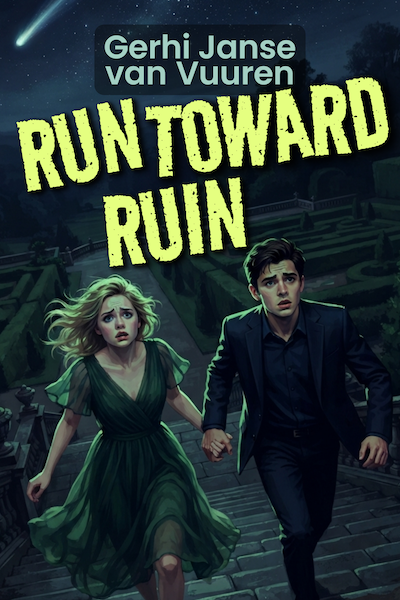
Run Toward Ruin – Chapter 3
Seventeen-year-old Darius is handed an impossible gift: the power to travel back in time and undo the injury that crippled his grandfather. It should have fixed everything. Instead, it breaks the present for everyone else. Still bound to the old man’s ruthless ambition, Darius must unravel a fractured timeline and a sinister plot—before the broken past hardens into a horrible present.
3. A Careful Catalogue
Cora came inside with Flawia. Piers fell into step behind them. It might have been late afternoon, but it was hot and the forecourt was baking. And Oswin Pochron’s entrance had taken up too much air.
“What are you trailing after like a lost puppy, Piers?” asked Flawia.
“Let him be,” said Cora, slapping her cousin politely on the wrist. “Who else is Piers going to hang with, but us?”
“Then don’t walk behind as if you are holding my towel,” said Flawia and extended a hand to Piers.
Unwillingly the tall young man walked up the stairs and took her hand. He was Cora’s foster brother and though he had been part of the family, and treated like a son for more than a decade, he still skirted the boundaries as if he was ready to break away at any sign of threat.
The stairs took them to the apartments where the adults stayed during the conclave. At the top Cora paused.
Flawia looked at what made Cora stop. At the other end of the corridor Darius Pochron was walking away from them.
“Ah, the Pochron boy,” said Flawia. “Thinks he’s a flashy driver coming with his own car.”
“I don’t think that’s quite right,” said Cora, brushing the tips of her fingers across her lips. “He drove…”
The absent-minded pat from Flawia told her that her fiery cousin wasn’t really listening. “Let’s wait for him to go round the corner then. I’ll say something you’ll regret if I run into him.”
“I’ll regret?”
“You know me. Not going to wait for permission.”
“What would you want to say?” asked Piers, who had walked to the centre of the landing, not bothering to stay out of sight.
“I don’t know, something such as you could have driven past with the old crank and nobody would have missed either of you?”
“Flawia!” snapped Cora. But that would have made everything different, if the Pochron boy and his grandfather were not a problem to be wary of.
“You know it is true. Remember last year when he made you and your mother cry for nothing either of you had done. I bet he has something exactly like that planned for this year.” She sneered. “Just have not had the chance to say it yet.”
“That’s old stuff,” said Cora. “We don’t want to dwell on it and don’t you dare bring it up.”
“Now where would I bring it up?”
Darius was out of sight for good and Cora started down the corridor.
“My mother said the Buhls are visiting briefly before we all have to prepare for dinner. Are you joining us?”
“No, I have to scrub off the sweat before I get into my nice dress. Going to have to marinate in the bath for at least half an hour.”
Cora let Flawia go and she bounced further up the stairs to the girl’s wing.
“I also need to—” started Piers.
“No, you are not.” Cora grabbed hold of his arm and dragged him down the corridor to her parents’ apartment.
“I’ll just be in the way,” complained Piers. “It is not as if anybody wants me there, really.”
From the volume of voices and laughter it was clear that the gathering in the Seisin apartments was lively. The noise seemed to push Piers even further back.
“No,” insisted Cora as she laid her hand on the doorknob, the other holding tight onto Piers’ arm. Flawia had already slipped away, she was not going to lose another one. “You are one of us.”
When they entered the door everybody looked up. A boy at the back, Olavi, sat up like a squirrel. He jumped right through the middle of the conversation and made straight for Piers.
Piers got his hand loose from Cora just in time to prevent injury as the tackle nearly took him off his feet and against the back wall. But the giant smile on his face said the attack was not unwelcome.
Olavi’s father, Ferran Buhl let out a roaring laugh.
“Mind the rascal, Piers. He’s been wrestling with sailors and doesn’t know his own strength anymore.”
Piers turned quite red when he looked up and saw that all eyes were on him.
“No, I’m fine,” he said and then he dropped down on one knee. “Hey, Olavi. What’s being out to sea like?”
Olavi launched into a rapid explanation but Cora could not hear the answer. The conversation had tumbled on loudly with the overlapping telling of stories. The Buhls had just returned from an extended voyage. Ferran had taken them all on one of the larger trade ships to make a tour of the Dim-Luta Islands.
The apartment faced west letting in the afternoon light. The latticed screens made the sunlight fall across the mosaic floor in a golden patchwork. It was as if all of them were sitting together on a magic carpet. Cora breathed it in.
Then the adult conversation picked up with something Ferran Buhl remarked that made everybody else laugh.
“You have given Hass a chance to practice his leadership,” said Roosa, Cora’s mother.
Across the heads of the adults Cora could see Hass Buhl listening to the words. He seemed pleased with himself.
Ferran leaned back and looked at his son. “It is so easy on a ship. You make them part of the crew and it happens naturally.”
“Wren as well?” asked Tomis, Cora’s father.
Ferran dropped his face in his hands laughing.
“She wanted to, of course,” answered her mother, Senne Buhl. “But I wouldn’t let her. Have a fifteen-year-old girl sleep with the sailors?”
Olavi dragged Piers to the table in the middle between the adults. Piers halted himself, barely. Olavi grabbed a handful of candied fruit from a bowl.
Ferran caught his son and turned him round in mid-air so that he ran right back to Piers again.
“Wren gave you the cold shoulder for days,” chuckled Ferran.
Senne shrugged. She picked up the bowl and passed it around and changed the subject.
“You should see their fields,” she said as she demonstrated with her hands. “They plant in wavy lines, not the straight way we do. The sunlight falls across and it is as if the land moves.”
“When have you planted anything, my dear,” asked Ferran as he reached back to take hold of her hand.
Senne laughed and looked at Roosa. “You know what I mean. We, as in over here, not as if I’m farming.”
“We plant straight because our fields are small,” said Roosa. “There’s no space for drawing pictures.”
Cora watched her mother, sitting with the bowl of candied fruit on her lap, not taking any for herself.
There was much more to tell and still news to hand back and forth. Though the work at home with the farms had been quieter, it had not been without incidents.
Roosa was thinking about the fields and hardly listening to all the sights Senne, Wren, and even Hass described in turn. Cora could see the worry pinch the wrinkles around her eyes. The yield had been less than expected.
After describing the vibrant fabric markets of Dim-Luta, and counting on his hand the new trades he had negotiated, Ferran paused and looked distant. When he continued his voice was lower.
“The accounts Oswin Pochron had sent back—there is a possibility he’d read them wrong. Or, read them his own way.”
Roosa Seisin snapped out of her reverie. “It would complicate things in the meeting.”
Tomis stood up. She watched him. He always stepped back physically when business came up. It was a way he acknowledged to himself he was not in charge of the family business, Roosa was. He only married into it.
Even thinking about it made Cora wonder. One day it would be her role to take on. Would she be able to?
“What do we have to be on guard for?” asked Roosa.
Ferran patted his hand on his knee. “The question is, what changed during the last year that might seem as if it had not been handled well?”
“According to Oswin Pochron, right?” added Senne.
Roosa folded her arms before she spoke. “Right, because he will have a paper with a clause or a correction and we will argue around it for days.”
Her mother’s courage made Cora sit up and draw in her breath. A similar argument last year had left her in tears. Now she seemed better prepared.
It was good Steward Komassa had removed the first tea of the conclave from the programme. Nobody wanted to be reminded of last year.
Tomis leaned in and squeezed his wife’s shoulder. “Komassa would not let him do that again, would he?”
Ferran sat up. “Why Komassa, isn’t the Prince—”
“No, again only a word but not a face.”
The conversation fell silent. Nobody said anything but Cora could feel the question in her bones. How was the Prince still able to keep things in order at a distance?
“What did Oswin note in the accounts, Ferran,” asked Roosa.
“I only had time to look over them briefly in the car. But he wrote a question in the margin, a demand for clearer financial accountability on shortfalls in light of recent ventures.”
“You have free rein to pursue new business.”
“I know, but there are always risks. Are they justified?”
“Do you believe in what you have done?”
Ferran threw his hands in the air as he looked for the words, and Senne spoke for him.
“Of course he does. You know how much he frets before he makes a decision.”
“Guilty,” said Ferran and dropped his eyes.
Roosa Seisin’s eyes flickered between her husband and Ferran Buhl. “You have my support, Ferran. You know that. But we will go through the records together and list any question Oswin might have and answer them before he asks.”
The bowl eventually reached Cora. She picked a bright green piece from a fruit she did not recognise. It was tart, sweet, and salty at the same time. She wasn’t sure if she liked it.
“Do we have to be so calculated?” asked Tomis.
Cora looked up. She did not hear what was said to make her father ask that. But the answer was in the looks the adults exchanged. The Buhls and the Seisins: the easiest alliance at this conclave, the one with the least secrets.
Was it a weakness? To need familiarity this much? To feel Oswin Pochron like a splinter under the skin?
Wren Buhl grabbed hold of Cora’s elbow and pulled at it.
“Come, let’s go outside. It’s stuffy in here.”
Cora let her gaze run over the gathering. It wasn’t stuffy, but as the sun was dipping the light in the room had dimmed. With it the conversation had gone quieter, more subdued. No, stuffy was not the word, it was serious.
She smiled at the slender dark-haired girl. Wren looked as if she took everything seriously, but under it Cora knew she was a naughty little sprite that could hardly sit still for a moment. She allowed herself to be dragged out on the balcony.
She looked back as if the other children would follow them out. Piers and Olavi were already gone. Where to she could not tell. Probably playing hide and seek in the hallways. Like his older sister Wren, Olavi was an inexhaustible bundle of energy.
Hass followed, casually. He could have stayed with the adults but amongst them he was quiet.
“Tell me more about your trip,” said Cora. “You had been gone almost two months.”
“I know. I missed you so much. You should have come along with us. Your mother would have let you.”
“I know she would. And I would have loved to but there were things to tend to.”
“About that,” said Wren. She looked over her shoulder at Hass. “Could I, now?”
Hass nodded, a slim smile on his face, his arms crossed as he leaned against a balcony pillar. “Of course.”
“Don’t go anywhere,” said Wren. She slipped back inside and past the adults.
“She has a surprise for you,” said Hass. “She’ve been itching with it since Dim-Luta. Nothing big but she… You know how she can’t keep a secret.”
Cora grinned. “You are not doing so well yourself at the moment.”
“Oh, I’m spoiling nothing,” said Hass.
Moments later Wren was back, her one arm tucked behind her back. “Sit,” she said.
Cora made herself comfortable on the stone bench. She felt like a queen getting ready to receive an offering.
“When I saw this, I knew I had to get it for you.”
“Don’t lie. You wavered for three days. We picked it up half an hour before the ship left because you finally admitted to yourself you could not let it go.”
“Hass wouldn’t let me give it to you until we were inside.”
“He said to wait,” Hass said from across the balcony.
“You should not,” said Cora. “I don’t need anything.”
“You don’t, but you would want this.”
Wren pulled her arm out from behind her back and handed Cora a parcel. It was heavier than it looked. She pulled the ribbon holding the wrapping free and the paper fell open to reveal a book. It was hand-bound in green leather with gold decoration in a pattern of overlapping flowers and leaves.
Cora felt the weight of it in her hands.
“This looks expensive.”
“Open it.”
She laid it on her lap and turned the pages slowly. One after another revealed dense, meticulous illustrations. Botanical drawings of plants, seeds, flowers, root systems, cross-sections, the exact shape of fruit at full ripeness. All that could be captured to get to know them. Every one a strange variety she had never seen before.
“It’s a plant catalogue,” Wren said. “From the valley growers in Dim-Luta. All done by hand. Coloured and everything.”
“It’s too much,” said Cora.
“It’s really a gift from us all,” said Hass.
“You just want to get some credit for it,” said Wren, reaching out to box him on the shoulder.
“If I didn’t go to the shop with you ten times, you would never have made up your mind. So, I’m taking as much credit as I can get.”
“Thank you,” Cora said.
She closed the book and held it tight on her lap. Her mother would want to read every word of it. Maybe it would give them a reason to travel as well.
From the inner room she could hear the adults’ voices—her father’s careful register, Ferran Buhl’s easier one, her mother’s sweet and direct.
This was all she wanted, for everything to be always like this. A family and their familiarity feathered with warmth and trust. It was something she would fight anybody for to keep. Just let anybody try to take it away from her.
© Gerhi Janse van Vuuren